


Why Is There Condensation in My Home? Understanding Moisture, Cold Spots and Thermal Bridges
Why is there condensation in the corner of my room?
Why does water keep appearing around my windows?
And why does mould seem to appear in exactly the same places every winter?
You may notice black mould in the corners of rooms, condensation running down your windows, damp patches around window reveals, or moisture appearing on cold walls. It is easy to assume that the problem is simply too much moisture or humidity in the home.
But persistent condensation and mould are rarely quite that simple. A room can have perfectly reasonable humidity levels while condensation and mould develop in one particular corner. A window can be covered in condensation while the wall next to it remains completely dry.
Understanding the relationship between moisture, humidity, temperature and cold surfaces is the first step towards understanding why condensation and mould develop in your home, and what you can do about it.
What actually is condensation?
At it’s most basic, condensation occurs when water vapour in the air turns back into liquid water.
It sounds simple, but understanding why this happens is the key to understanding condensation, damp and mould in your home. The air inside your home contains water vapour. Every day, moisture is added through ordinary activities such as:
- breathing and sleeping
- cooking
- showering and bathing
- drying clothes
- washing dishes
- houseplants
- even normal evaporation from people and stored water
One of the most important things to understand is that warm air can hold more water vapour than cold air. There is a limit to how much water vapour the air can contain at any given temperature. When it reaches this limit, the air is saturated. Relative humidity tells us how close the air is to this saturation point.
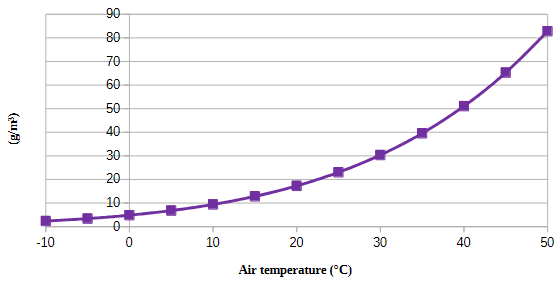 Figure 1: Moisture Carrying Capacity of Air at Different Temperatures
At 20°C, air can contain considerably more water vapour than it can at 10°C. Cool the same air down far enough and eventually it reaches the point where it can no longer hold all of its moisture as vapour. If the warm, humid air comes into contact with a surface that is at or below this dew point temperature, some of the water vapour can condense into liquid water. No, it is not magic, but vapour pressure.
A window is visibly cold because it separates your warm home from the outside. A wall may appear perfectly normal while containing much colder areas that are not obvious to the eye.
These are often associated with thermal bridges.
Why are some parts of a building colder than others?
If a house were constructed as one continuous layer of perfectly uniform insulation, every part of the internal surface would theoretically be at a similar temperature.
Real buildings are not like this.
They contain corners, junctions, windows, doors, balconies, floor slabs, structural elements, penetrations and connections between different parts of the building. Different materials have different thermal resistance properties. Its the reason you wear a jacket on a cold day.
These details can allow heat to escape more easily. Resulting in a variation of surface temperatures across the building. One section of wall might have an internal surface temperature of 18°C while another, only a metre away, might be significantly colder.
This matters because condensation is controlled by the local surface conditions, not the average temperature of the room.
What is a thermal bridge?
A thermal bridge is a part of a building where heat flows more easily through the construction than it does through the surrounding building elements.
The term “bridge” is useful because heat is effectively finding an easier route from the warm side of the building to the cold side.
Thermal bridges can occur for many reasons.
For example:
- insulation may be interrupted
- different construction materials may meet
- a concrete slab may pass through an insulated wall
- a structural column may connect the inside and outside
- a window may be poorly positioned within the wall
- insulation may have been installed poorly
- the geometry of a junction may increase heat loss
- an older building may simply have been constructed without modern thermal-bridge considerations
The result is often a colder internal surface. And this is where the moisture in your home becomes important.
The air in the entire room may contain the same general amount of moisture, but condensation does not necessarily occur throughout the room.
Instead, it occurs where the moisture encounters a sufficiently cold surface. This is why condensation and mould can repeatedly appear in very specific locations.
Why does condensation appear in the corners of rooms?
Room corners are one of the classic locations for condensation and mould. Consider an external corner. A flat section of external wall has a relatively straightforward heat-flow path. Heat travels from the room, through the wall and towards the outside.
At a corner, the geometry changes. There is more external surface area relative to the internal surface area, and the heat-flow pattern becomes more complex. The internal corner can therefore become colder than the middle of the wall.
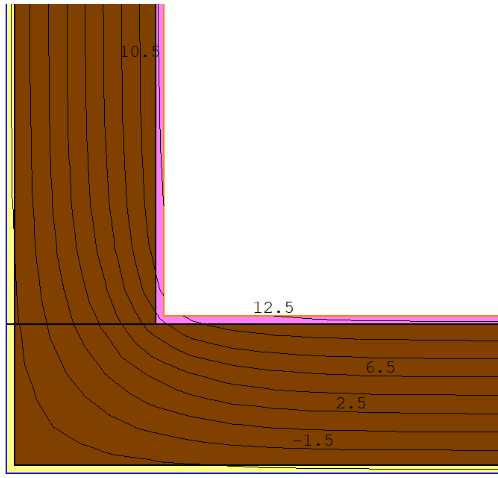
Figure 2:Heat transfer at an External Corner
The result can be a surface that looks perfectly ordinary but has a significantly lower temperature than the surrounding wall. Figure one has an internal air temperature of 20 °C. on the plaster (pink) side of the masonry wall (brown). The external temperature is -5°C where the render (yellow) is. Isotherm bars show the reducing temperature as you move from inside to outside through the structure. You can clearly see the 12.5 and 10.5 degree isotherms are broken at the internal corner.
The entire room may contain a large volume of humid air. But that moisture does not need to condense across the whole room. It only needs one sufficiently cold surface. The corner effectively acts as the location where the moisture reaches its limit.
Why do windows and window reveals suffer?
Windows are another common location for condensation. Glass generally has a much lower thermal resistance than a well-insulated wall. In winter, the external temperature can therefore have a significant influence on the temperature of the internal glass surface.
This is particularly noticeable with older single-glazed windows. The internal surface of the glass can become cold enough for condensation to form. But the glass itself is not necessarily the only problem. The area around the window can also be vulnerable.
The window reveal is the section of wall surrounding the window opening. Depending on how the window is positioned and how the surrounding wall is constructed, heat can flow through this junction more readily than through the main wall, because the path for heat transfer is shorter.
This can create a colder surface around the edge of the window.
You may therefore see condensation or mould:
- on the glass
- along the edge of the frame
- at the junction between the frame and wall
- on the window reveal
- above or below the window
- in the corners of the reveal
This is particularly important in older buildings where windows may have been replaced without fully considering the surrounding construction, while a new window can have excellent glass insulation but still leave a problematic thermal bridge around the opening.
The performance of a window therefore cannot always be understood by looking only at its centre-of-glass U-value. The surrounding junction matters too. Check out our blog on the most overlooked insulation. Insulating window reveals!
Problematic buildings
Poorly retrofitted older buildings, design errors and critical construction errors can result in condensation issues. Sometimes there is one principal factor, but more often there are multiple levers that need to be adjusted to rectify the issue.
Old buildings and condensation
Older buildings require particular care when diagnosing condensation. It is tempting to say that an old building has condensation because it was “poorly built”. That is not always accurate.
Buildings were designed according to the knowledge, materials, regulations and expectations of their time. Many older buildings relied much more heavily on natural ventilation. Air leakage through windows, doors, chimneys, floorboards and other parts of the building could provide a significant amount of background ventilation.
This was not necessarily considered a defect. It helped remove moisture from kitchens, bathrooms and occupied rooms.
The problem can arise when an older building is renovated without considering how its ventilation strategy has changed.
For example, replacing old draughty windows with highly airtight modern windows can significantly reduce uncontrolled air movement. The building has not necessarily become “worse”. But the balance between moisture generation and moisture removal has changed. If the occupants continue generating the same amount of moisture but less moisture is being removed through ventilation, indoor relative humidity can increase.
At the same time, the building may still contain its original cold bridges. The combination can create ideal conditions for condensation and mould.
Poor thermal performance can make the problem worse
Older construction can also contain thermal bridges that would be avoided or reduced in modern construction.
Examples include:
- uninsulated masonry
- concrete structural elements
- poorly insulated junctions
- window openings with limited insulation
- projecting balconies
- floor and wall junctions
- roof-to-wall junctions
- poorly executed repairs
- gaps or discontinuities in insulation
There is also a difference between design and construction quality.
A building can be designed to perform reasonably well but fail to achieve that performance because the construction was not executed correctly. Insulation can be missing, compressed or poorly fitted. A junction can contain gaps. A window can be installed in a position that creates a significant thermal bridge. Even a seemingly good repair can introduce a new material with very different thermal properties.
Consequently, diagnosing condensation should not begin with the assumption that one particular cause is responsible.
The building needs to be considered as a system.
How occupant behaviour affects it
It is also important not to blame every condensation problem on thermal bridges. The amount of moisture inside the home matters enormously. Consider two otherwise identical homes.
If one has an indoor relative humidity of 40% and the other has 70%, the second home has a substantially greater risk of condensation when surfaces become cold. This is why kitchens and bathrooms are particularly vulnerable which generate large amounts of water vapour in relatively short periods.
Good ventilation is therefore an important part of condensation control.
This might involve:
- using kitchen extraction when cooking
- using effective bathroom extraction
- allowing moisture to escape after showering
- avoiding prolonged indoor clothes drying where possible
- maintaining appropriate background ventilation
- using mechanical ventilation where appropriate
However, ventilation should not be used as an excuse to ignore a serious thermal bridge. If a particular wall corner becomes extremely cold, increasing ventilation may reduce the amount of moisture available to condense, but it does not necessarily fix the underlying building defect.
A good assessment considers both sides of the equation:
How much moisture is being produced and removed?
How cold are the surfaces where that moisture could condense and why are they cold?
So, what can you actually do about it?
The first step is to establish why the condensation is occurring. Simply telling someone to “open the windows more” is not always an adequate diagnosis. Likewise, installing more insulation without understanding the existing construction can create new problems, particularly in older buildings.
A proper assessment should consider several factors together:
Indoor conditions
- temperature
- relative humidity
- moisture generation
- ventilation
Building construction
- wall build-up
- insulation
- windows
- floors
- roofs
- junctions
Thermal performance
- U-values
- thermal bridges
- internal surface temperatures
- temperature factors
Moisture risk
- surface condensation
- interstitial condensation
- mould risk
- drying potential
This allows the solution to target the actual cause. We can help.
How Resolve Sustainability Consulting can help
At Resolve Sustainability Consulting, we approach condensation as a building-physics problem rather than simply a ventilation problem.
For homeowners, this can start with an assessment of the building construction and the conditions under which condensation is occurring.
Where appropriate, we can use thermal modelling to investigate specific problem areas. For example, 2D thermal-bridge modelling can be used to examine a window reveal or external wall corner and determine how heat flows through the junction.
This can show the predicted internal surface temperature rather than simply assuming that the whole wall is at one uniform temperature. That information can then be considered alongside indoor temperature and humidity conditions.
As consultants for complex sustainable retrofit, we can also assess proposed improvements before they are installed. This can be particularly valuable where insulation is being added to an older building. Adding insulation can significantly improve thermal performance, but the detailing around windows, floors, ceilings and junctions still matters. The objective is not simply to add as much insulation as possible.
The objective is to produce a retrofit that is thermally effective, moisture-aware and appropriate for the existing building.
Condensation is ultimately a balance between moisture, ventilation and temperature. It is a symptom of an imbalance. We identify practical retrofit measures to improve comfort and reduce condensation risk.
