


Smart Membranes: How Do They Work?
A newer category of construction membrane is becoming increasingly relevant to retrofit and energy-efficient construction, the smart membrane.
Unlike conventional membranes, a smart membrane can change its resistance to water vapour depending on the moisture conditions. Its sd-value changes, allowing the membrane to become more vapour-resistant when conditions are dry and more vapour-open when humidity increases.
Traditionally, construction membranes have generally been used for three main purposes. Roofing membranes provide protection from liquid water and weather while, depending on the type, allowing water vapour to escape from the construction. A damp proof membrane (DPM) is specifically intended to resist moisture from the ground coming up into the construction. Vapour control layers (VCLs) are used on the warm side of an insulated construction to limit the movement of water vapour into the building fabric.
Smart membranes are a type of VCL take this a step further by adapting their vapour resistance to the conditions within the construction.
What is a smart membrane?
A smart membrane is a moisture-control membrane whose resistance to water vapour changes depending on the surrounding humidity. Smart membranes can become more vapour-open when humidity increases and more vapour-resistant when conditions are dry. One example is Pro Clima INTELLO, which is designed for use as an airtightness and vapour-control layer within building assemblies.
How does it work?
The key property of a smart membrane is its variable sd-value. The sd-value describes the equivalent thickness of air that would provide the same resistance to water vapour diffusion as the membrane. A high sd-value means that the membrane is relatively resistant to vapour diffusion, while a low sd-value means that it is more vapour-open.
With a smart membrane such as INTELLO, the sd-value changes according to the relative humidity at the membrane.
During winter, indoor air is typically warmer and contains more moisture than cold outdoor air. A smart membrane such as INTELLO generally provides high vapour resistance under dry conditions, helping limit moisture entering the colder parts of the construction. If humidity increases, the membrane becomes more vapour-open, allowing greater potential for the construction to dry towards the interior.
This behaviour is particularly useful in retrofit applications where internal wall insulation is being considered.
Why is this important for internal wall insulation?
Internal wall insulation changes the temperature and moisture conditions within an existing wall.
When insulation is installed on the inside of a solid wall, the existing masonry becomes colder during winter. If warm, humid indoor air is able to reach colder parts of the construction, there is a greater potential for interstitial condensation. A conventional vapour control layer can reduce this risk by restricting vapour diffusion into the wall. However, it can also restrict drying if moisture becomes trapped within the construction.
A smart membrane aims to provide a balance between these two requirements, limiting moisture entry under normal conditions while allowing increased drying when humidity within the construction rises.
This does not mean that a smart membrane makes an internal insulation system automatically safe. The complete wall build-up still needs to be designed and assessed for moisture risk, including thermal bridges, airtightness, workmanship and the ability of the construction to dry.
Comparing the different wall constructions
The Glaser analysis below provides a detailed comparison of the existing and proposed wall build-ups, showing the distribution of actual and saturation vapour pressures through each construction.
Vapour pressure is the pressure exerted by water vapour molecules in the air. The more water vapour there is, the higher the vapour pressure.
Checking for the interstitial condensation potential in a retrofit is important. The assessment must therefore consider not only the temperatures through the construction build up, but also the moisture transport mechanisms and vapour resistance of the proposed wall build-up.
In the example. vapour-open, hygroscopic wood fibre has been modelled, 80mm thick to the inside of 360mm of masonry. Wood fibre is a hygroscopic insulation material and can absorb and redistribute moisture within the material. This moisture-buffering behaviour can contribute to the robustness and drying potential of the construction, although it is not fully represented by a simple Glaser calculation
As water vapour moves through a building construction, two vapour pressures are important. Saturation vapour pressure is determined by the temperature at each point within the wall. As the wall becomes colder, the amount of water vapour the air can hold decreases, and therefore the saturation vapour pressure also falls. Actual vapour pressure represents the amount of water vapour that is actually present and is influenced by the indoor and outdoor conditions and the resistance to vapour movement through each layer. When the actual vapour pressure exceeds the saturation vapour pressure at any point within the construction, the air is unable to hold all of the water vapour and condensation may occur. In a Glaser calculation, this is therefore the point at which interstitial condensation is predicted.
Figure 1 – Existing insulated wall:
The first graph shows the existing wall construction and the calculated vapour pressure and saturation vapour pressure through the build-up. Notice that the actual vapour pressure overcomes the saturation pressure in the first 20mm of the wall. This could manifest itself as condensation on the inside of the wall.
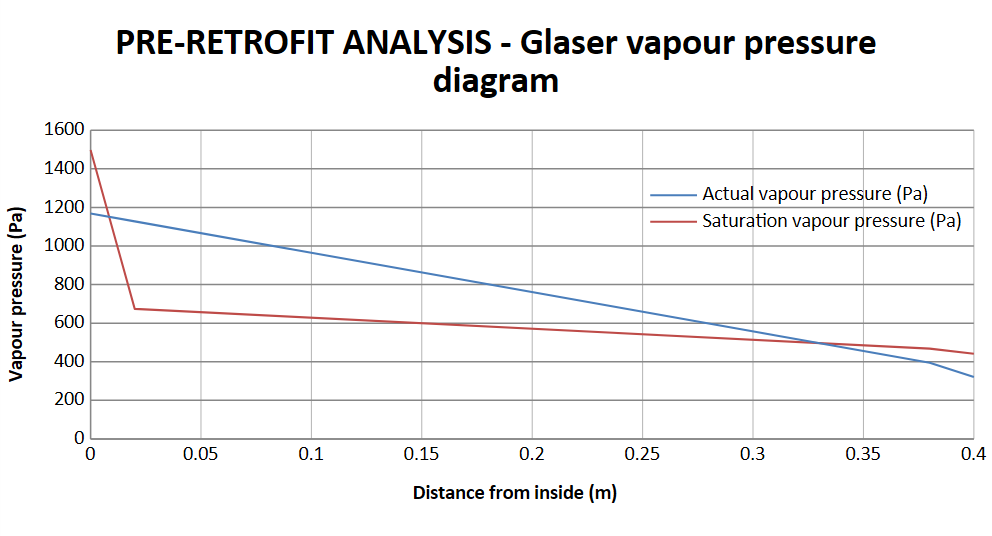 Figure 2 – Internal wall insulation:
The second graph shows the same wall after internal insulation has been added. The wall increases in thickness from 0.4m to 0.48m. Moving the insulation to the inside changes the temperature profile through the wall and can increase the moisture risk within the existing masonry. As the saturation vapour line drops considerably. Not the Actual vapour pressure overcomes the saturation 90mm into the wall construction. This is in the insulation layer. The problem with this is the condensation would form within the construction., known as interstitial condensation. It is risky to have moisture in the construction it could lead to rotting and masonry damage such as salts and freeze thaw.
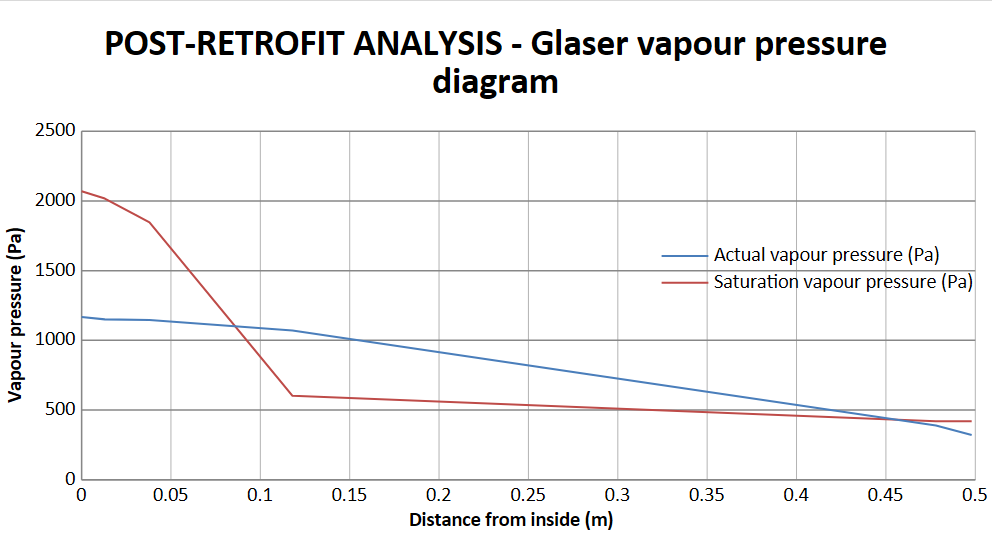
Figure 3 – Internal wall insulation with a smart membrane:
The third graph shows the wall with internal insulation and a smart vapour-control layer such as INTELLO. The membrane provides a high sd-value under relatively dry conditions but becomes increasingly vapour-open as humidity rises, providing greater potential for the construction to dry. The sudden drop in the actual vapour pressure signifies where the membrane sits approximately 45mm from the internal surface. The sharp reduction in vapour pressure across the membrane demonstrates the high vapour resistance provided by the INTELLO layer under the conditions modelled, it clearly ensures the actual vapour pressure is prevented from overcoming the saturation pressure. Consequently, under the assumptions and boundary conditions used for this Glaser assessment, no interstitial condensation is predicted.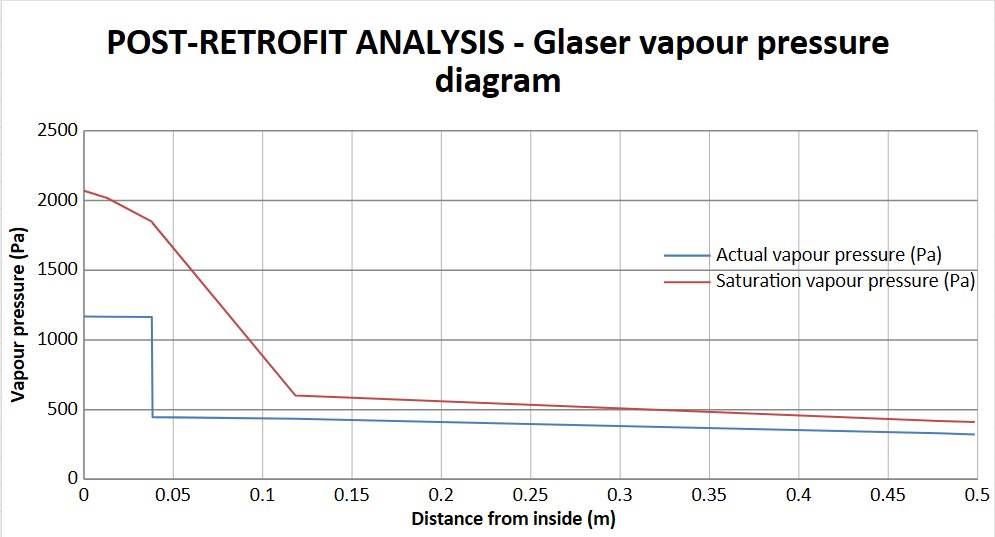
Where are smart membranes used?
Smart membranes are particularly useful where moisture management and airtightness need to be carefully controlled. Common applications include:
- Internal wall insulation
- Roof and loft insulation
- Timber-frame construction
- Renovation of older buildings
- Highly insulated building envelopes
- Situations where drying potential is an important part of the design
They can be particularly valuable in retrofit projects because existing buildings often have less predictable construction and moisture characteristics than new-build assemblies.
A membrane is not a substitute for good design
Smart membranes are a useful tool, but they are not a solution to every moisture problem.
Retrofitting an older building is not simply a matter of adding insulation. Changing the thermal performance of a wall also changes its temperature and moisture conditions, and poorly designed insulation can introduce new risks that were not present in the original construction.
At Resolve Sustainability, we take a fabric-first approach to retrofit, combining energy performance with moisture risk and practical construction considerations. We can assess existing and proposed wall build-ups to understand how insulation, vapour control, thermal bridges and ventilation interact.
Depending on the project, this can include Glaser analysis, hygrothermal assessment, thermal-bridge analysis and detailed consideration of the proposed construction build-up. Where internal wall insulation is being considered, we can assess whether the proposed materials and vapour-control strategy provide an appropriate balance between limiting moisture entry and allowing the construction to dry.
The objective is not simply to achieve a lower U-value. A successful retrofit should also provide durable moisture control, improved comfort and a construction that can perform safely over the long term.
If you are considering internal wall insulation or another energy-efficiency upgrade, Resolve Sustainability can help assess the existing construction, compare retrofit options and develop a practical, evidence-based design before work begins.
