

What you must know about Retrofit Coordinator and PAS 2035!
PAS (Publicly Available Specification) is the UK Government’s initiative, developed by the British Standards Institution, to tackle urgent challenges across many critical sectors, including climate change, digital infrastructure, and innovation. When looking to address the gaps and failures in the UK’s attempts to implement sustainable retrofit over the years, many people would argue that a lack of overall coordination has meant that schemes have failed time and time again. The ever improving retrofit standards and the Retrofit Coordinator role look to close those gaps.
As sustainability consultants, we are specifically interested in the retrofit standard framework provided for industry professionals to ensure repeatable and thorough analysis, evaluation, and design of retrofit solutions for homes, businesses, and industry in order to tackle climate change.
When were the retrofit standards created?
The PAS for UK retrofit standards was initially adopted with a focus on installers, beginning with the first edition of PAS 2030 in 2012. It then went through several iterations:
- PAS 2030:2014
- PAS 2030:2017
- PAS 2030:2019
- PAS 2030:2021
- PAS 2030:2023
In 2019, a new standard, PAS 2035, was established as a process guide for whole-house retrofit. It was seen as a necessary step to formalise the management process, aiming to leave fewer overlooked areas for construction professionals and, therefore, improve the reliability of the retrofit process.
- PAS 2035:2019
- PAS 2035:2021
- PAS 2035:2023
Both PAS 2030 and PAS 2035 were updated in 2021 when a new non-domestic standard, PAS 2038, was introduced. With a focus heavily around the decarbonisation of industry whilst recognising the business challenges for commercial properties.
- PAS 2038:2021
What are the retrofit standards used today?
The UK currently has 3 retrofit standard operating today.
1) PAS2030 for the installation of energy efficiency measures.
2) PAS2035 is a framework for the design and installation of whole house retrofits.
3) PAS2038 a retrofit framework for non domestic energy and carbon savings
PAS 2030
PAS 2030 is the UK’s standard for the installation of energy efficiency measures and formed the foundation for sustainable retrofit practices before the introduction of PAS 2035.
The standard establishes the minimum requirements for installers, including competency, training, and quality assurance processes. Its primary goal is to ensure that retrofit measures are installed correctly so that energy performance improvements are reliably achieved. While PAS 2030 does not cover the full lifecycle of a retrofit, it is an essential part of the broader framework and provides the technical foundation for PAS 2035. In fact, PAS 2035 incorporates PAS 2030 within its framework, highlighting that proper installation remains a critical element of successful retrofits.
A key element of PAS 2030 is the emphasis on installer competence and certification. Installers must be trained to a recognised standard and be capable of delivering consistent results across different types of measures, whether insulation, heating systems, or ventilation upgrades. The standard also mandates regular audits, checks, and quality assurance procedures to ensure that installations are completed to specification. This focus on oversight and verification is vital to maintaining the credibility of retrofit programs and ensuring long-term energy savings.
Another critical aspect of PAS 2030 is traceability and documentation. Installers are required to maintain comprehensive records of all work completed, including materials, methods, and any deviations from the plan. This documentation ensures accountability and allows future assessors, evaluators, or coordinators to review the work and identify any potential issues. It also serves as a foundation for learning and continuous improvement across the industry.
PAS 2030 ensures that each individual sustainability measures are installed correctly, reliably contributing to the overall success of retrofit projects.
PAS 2035
The new standard marked a shift away from focusing solely on the installation process. It came with the realisation that the effectiveness of sustainability measures is not determined solely by installation. Success is actually driven by the proper specification and design of the retrofit as a whole, since each measure interacts with the others.
So much so that the PAS 2035 framework, actually incorporates PAS 2030 within it, this is visually demonstrated in the flow chart below. It highlights that effectiveness is the result of a larger process of analysis from the start to the end of the retrofit.
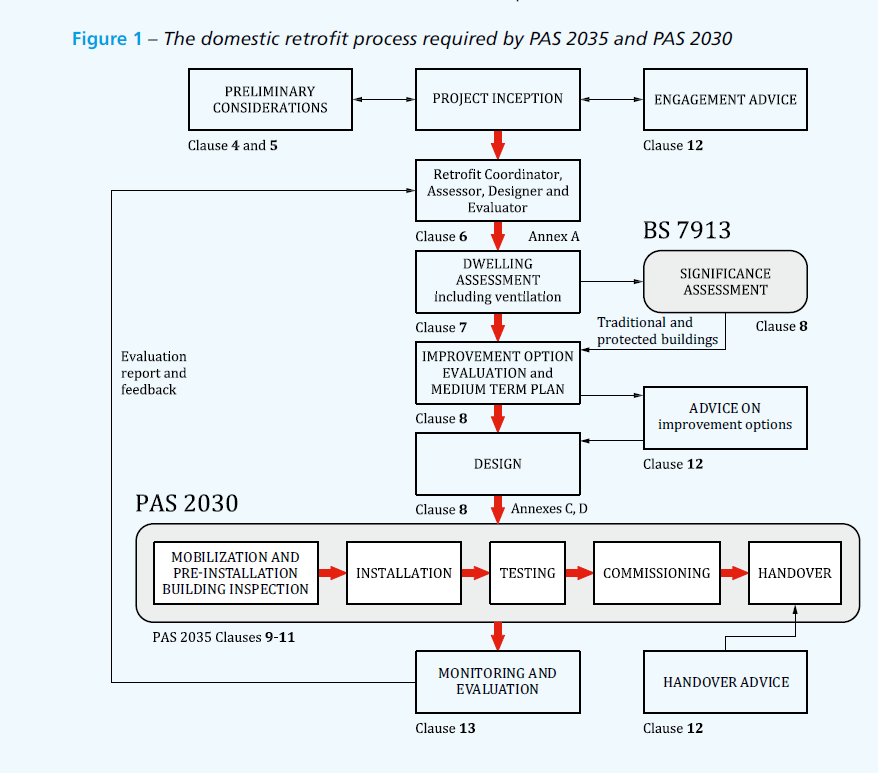
Perhaps the most important takeaway from PAS 2035 is the identification of the project team, with each member assigned specific roles within the process, all of whom must be qualified construction professionals but also PAS certified. One of these roles is the retrofit installer, which we discussed above in the section on PAS 2030.
Project Team
There is a designer, responsible for the technical design of the retrofit. This individual can be seen as the engineer or architect behind the project. When it comes to the specifics of what is to be installed, the designer is the most knowledgeable. It is therefore crucial that the designer’s time is spent entirely on this, developing the detailed design and specification.
The retrofit assessor is tasked with collecting accurate and comprehensive information about the current building prior to the retrofit. In many cases, projects fall short of expectations or are significantly underestimated if the desk and site assessment is not thorough. As the saying goes, “garbage in, garbage out,” and the retrofit assessor ensures that the rest of the team is not working with poor-quality information.
The retrofit evaluator is integral to the ongoing improvement of the scheme and industry knowledge. Without a thorough post-completion analysis, it would be impossible to learn from each project. While evaluators are often overlooked on individual projects as ideally every project would satisfy all its anticipated goals, Evaluators ensure that future projects can be completed with a larger database of knowledge and understanding. We must always remember that the long-term goal of all PAS retrofit standards is to help the UK achieve its carbon neutrality targets by 2050. This can only be accomplished through collective growth and understanding.
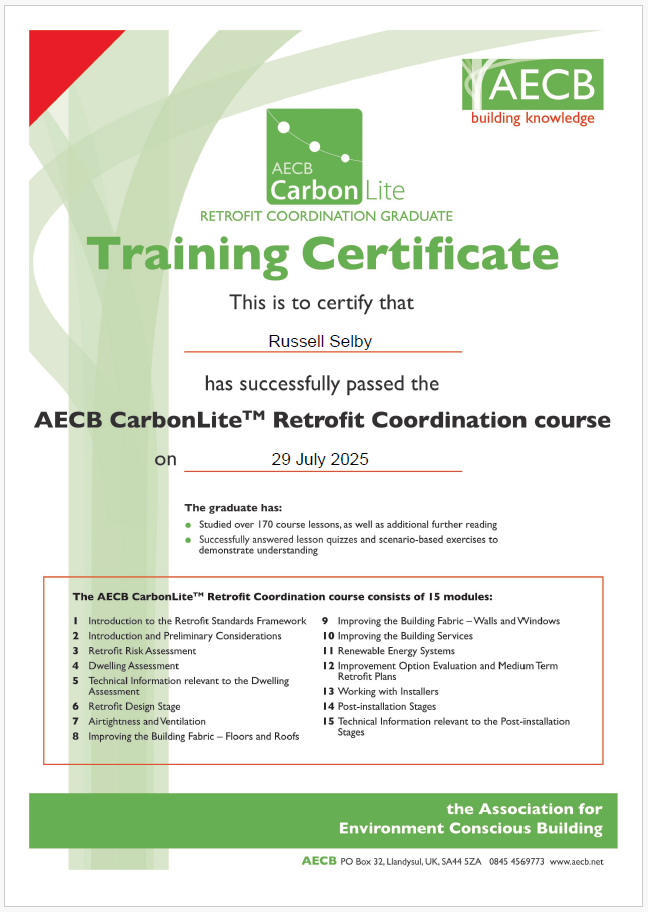
Resolve Sustainability Consulting sees one role as integral to the entire framework: the Retrofit Coordinator. Our team members are qualified Retrofit Coordinators, and this role, as explained in detail below, acts as the project manager with a comprehensive understanding of all facets of the framework. Importantly, the Retrofit Coordinator also has the knowledge and ability to perform the other roles on the team when circumstances allow. They can assess or evaluate a building, and in relatively simple whole-house retrofits, can even act as the designer if appropriately qualified. The Retrofit Coordinator also has the deepest understanding of the PAS 2035 framework and is responsible for coordinating the project in full alignment with it.
PAS 2038
PAS 2038 is the UK’s standard for non-domestic retrofit, extending the principles of PAS 2035 into commercial, industrial, and public-sector buildings. PAS 2038 recognises that retrofit projects in larger or more complex buildings require a structured, whole-building approach, similar to PAS 2035, but adapted to the unique challenges of non-domestic properties.
The standard emphasises that the success of a retrofit is not determined solely by installation. Instead, it is driven by a coordinated process of assessment, design, installation, and post-completion evaluation. Each measure must be considered in the context of the entire building and its systems, as well as how it interacts with other planned interventions.
A key element of PAS 2038 is the project team, which mirrors the structure of PAS 2035 but is tailored to non-domestic buildings.
PAS 2038 also emphasises quality assurance, documentation, and risk management. Due to the complexity and scale of non-domestic buildings, every stage of the retrofit must be carefully recorded and verified. This ensures accountability, allows for performance verification, and provides a foundation for learning and improvement in future projects.
Does your retrofit team need to follow PAS 2035?
PAS is not legally required for private residential or private business projects. However, it is commonly required for projects funded under government schemes.
It is generally required for publicly funded projects, especially in schools, hospitals, council offices, or other public facilities. The requirement ensures proper project management, risk mitigation, and measurable energy and carbon outcomes.
This does not mean that the framework should not be used for a private whole-house retrofits. Applying it will help ensure proper risk management and mitigation, with clearly defined elements of the process: assessment, improvement analysis, an improvement plan, installation reporting, and post-installation evaluation. Resolve Sustainability Consulting use a report and process which is aligned with PAS 2035. Clients who are committed to significant decarbonisation and energy reduction would appreciate the transparency the framework insists on.
What is a Retrofit Coordinator?
The Retrofit Coordinator is the central figure in a PAS retrofit project, responsible for ensuring that the entire process runs smoothly and aligns with the relevant framework PAS 2035 for domestic buildings or PAS 2038 for non-domestic buildings. They act as the sustainability project manager, overseeing all stages of the retrofit from initial assessment to post-completion evaluation, but crucially with a level of technical understanding that can hold other team members accountable.
A Retrofit Coordinator ensures that each team member; assessors, designers, installers, and evaluators fulfils their responsibilities and that the project remains on schedule, on budget, and compliant with the standard. They are responsible for risk management, quality assurance, and coordination between multiple disciplines, ensuring that the project achieves its intended outcomes, including energy efficiency and carbon reduction.
Importantly, a Retrofit Coordinator is not limited to managerial oversight. Depending on the scale and complexity of the project, they may also perform other roles if qualified, such as:
- Acting as a designer on simpler whole-house retrofits.
- Conducting assessments or evaluations to support decision-making.
- They will always be expected to thoroughly evaluate the pros and cons of the each individual or package of measures.
Because the Retrofit Coordinator has a comprehensive understanding of the PAS framework, they provide continuity and coherence across the project, ensuring that all processes assessment, design, installation, and post-completion evaluation are delivered consistently and effectively. In essence, the Retrofit Coordinator is the linchpin of the retrofit team, safeguarding quality, compliance, and the long-term performance of the building.
How does Resolve Sustainability Consulting use PAS 2035 for sustainable retrofit?
As qualified Retrofit Coordinators, Resolve Sustainability Consulting can adopt the role described above. Depending on the scope or scale of the project, we work with other professionals; however, crucially, we have the knowledge and understanding to take on other roles when needed.
When we pair the Retrofit Coordinator’s project management role with our Passive House Designer qualification, we have the technical understanding required for design. In some cases, Resolve can act as a one-stop consultancy, supporting your sustainability needs from start to finish. Please feel free to contact us and discuss your project with no initial cost. We endeavour to make the retrofit process as smooth as possible. Whether that is answering some sticky question or alterative continual support and project management.